What makes Central Florida different from every national average:
Year-round AC operation with no seasonal recovery — nearly 11 months of continuous runtime
Persistent humidity that regularly exceeds 50% — the threshold where mold and dust mites actively colonize ductwork
Live oak, pine, and grass pollen cycles that run almost continuously with no true off-season
We've opened duct panels in homes with attentive owners, newer systems, and consistent filter changes — and found contamination levels we'd expect from systems twice their age. That disconnect is what pushed us to stop quoting national guidelines to local homeowners and start giving honest answers based on what we actually see on the job.
This page gives Altamonte Springs homeowners:
A cleaning frequency framework built on Central Florida field experience — not national averages
The household factors that accelerate or slow duct contamination in this specific climate
Clear warning signs that justify moving your timeline up
How consistent filter maintenance directly affects how often professional cleaning is needed
An honest framework for deciding — without relying solely on a company that profits from saying yes
The 3-to-5 year range isn't wrong. But in Altamonte Springs, where that range lands for your home depends on conditions most cleaning guides never address, which is why many homeowners turn to top duct cleaning near Altamonte Springs FL to better understand what their system actually needs. That's exactly what this page covers.
TL;DR Quick Answers
How Often Should Altamonte Springs Homeowners Get Duct Cleaning?
Most Altamonte Springs homes need professional duct cleaning every 3 years. The national 5-year guideline wasn't built for Central Florida's climate conditions.
Why every 3 years in this market:
Near year-round AC operation — approximately 11 months of continuous runtime
Humidity regularly exceeds 50% — the biological growth threshold for mold and dust mites
Live oak, pine, and grass pollen cycles run almost continuously with no true off-season
Contaminants recirculate through living spaces up to 7 times daily with no seasonal pause
Factors that push the timeline earlier than 3 years:
Pets or allergy sufferers in the household
Smokers or recent renovation/construction
Older duct systems with gaps or poor seals
Any active warning signs present
Factors that may allow 4–5 years:
Consistent MERV 8+ filter changes on schedule
Newer, well-sealed duct system
No pets, smokers, or allergy sufferers
No renovation history or moisture issues
Warning signs that override any schedule:
Musty odors returning within days of a filter change
Dust visible at registers shortly after cleaning
Allergy or asthma symptoms worse indoors than outside
Visible mold at registers or the air handler
Pest evidence inside ductwork
Before booking any Altamonte Springs duct cleaner:
Verify Florida contractor license — MyFloridaLicense.com
Verify NADCA certification — nadca.com/find-a-professional
ZIP codes served by Altamonte Springs duct cleaning providers: 32701 · 32714 · 32716 · 32751
Top Takeaways
The national 3–5 year guideline wasn't built for Central Florida.
Near year-round AC operation leaves no seasonal recovery period
Persistent humidity regularly exceeds the 50% biological growth threshold
Pollen cycles run almost continuously with no true off-season
Honest baseline for most Altamonte Springs homes: every 3 years — not 5
Your household conditions matter as much as the calendar.
Clean more frequently with: pets, allergy sufferers, smokers, recent renovation, older duct systems
May hold closer to 5 years with: consistent MERV 8+ filter changes, newer systems, no occupancy risk factors
Know which category your home falls into before deciding
Warning signs override any schedule. Act immediately if you notice:
Musty odors returning within days of a filter change
Dust visible at registers shortly after cleaning them
Allergy or asthma symptoms worse indoors than outside
Visible mold at registers or the air handler
Any pest evidence inside the duct system
Two or more present at once — don't wait
Duct cleaning and filter maintenance only work when paired together.
Cleaning removes existing buildup
MERV 8 or higher filter changed on schedule slows how fast buildup returns
One without the other consistently underperforms both together
Verify before you book anyone. Two checks — under two minutes:
Florida contractor license — MyFloridaLicense.com
NADCA certification — nadca.com/find-a-professional
Why the National Duct Cleaning Guideline Doesn't Apply Here
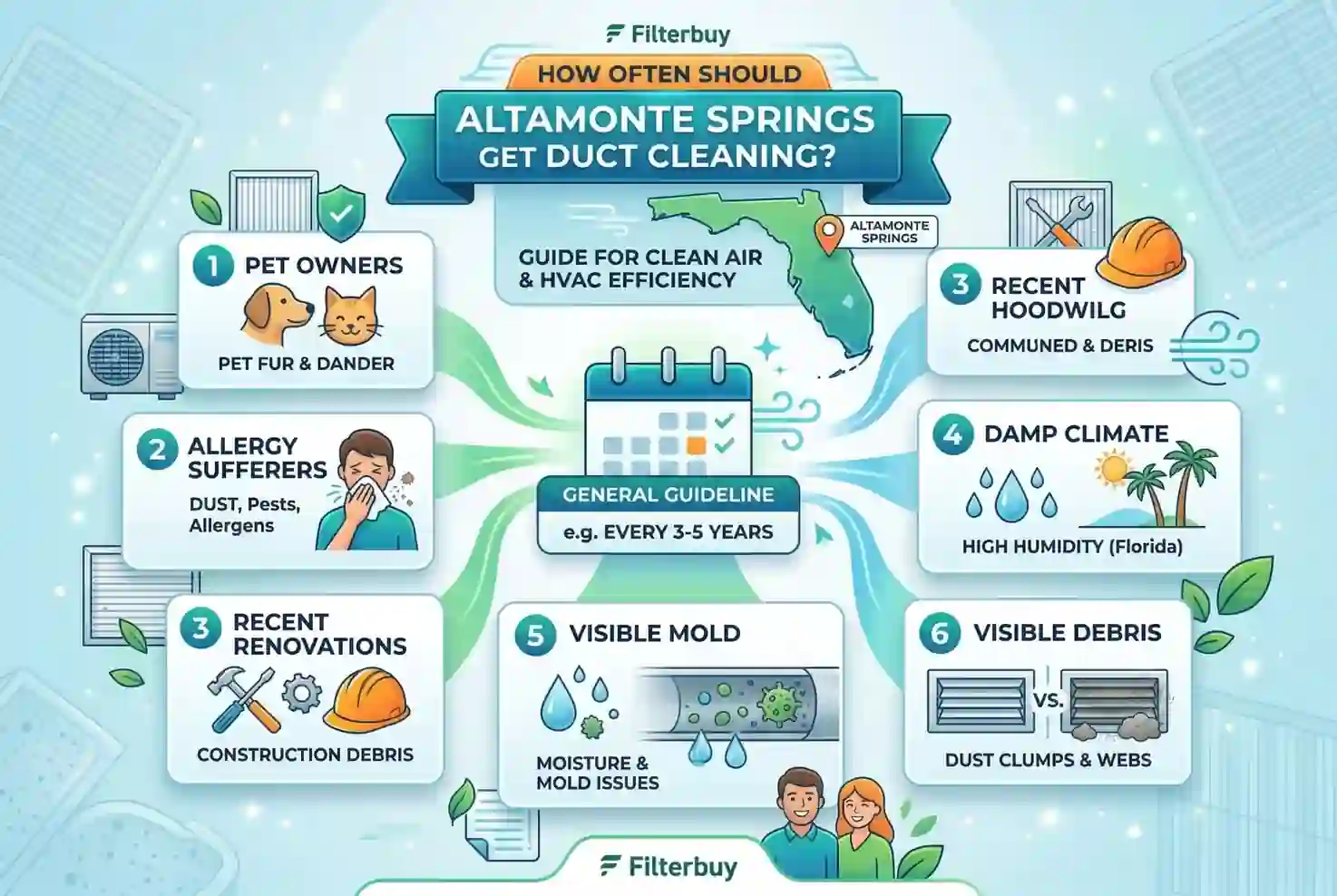
The standard 3–5 year recommendation comes from national averages — aggregate data pulled from homes across dozens of climate zones, many of which run their HVAC systems seasonally.
Altamonte Springs isn't seasonal. It's near year-round.
A home here that runs its AC 11 months annually accumulates duct contamination at a fundamentally different rate than a home in the Midwest that shuts its system down for four months every winter. When we account for that runtime difference alone — before factoring in humidity or pollen — the math already shifts closer to 3 years than 5, which is why many homeowners rely on top duct cleaning services to keep their systems cleaner and running efficiently.
The Three Climate Factors That Accelerate Duct Contamination in Altamonte Springs
1. Near year-round AC operation
No seasonal shutdown means no natural recovery period
Continuous airflow pulls particulate through the system 11 months a year
Contaminant accumulation compounds faster than any national average accounts for
2. Persistent humidity above critical thresholds
Seminole County outdoor humidity regularly exceeds 50% — the level where mold, mildew, and dust mites actively thrive
Ductwork that stays damp between cycles creates biological growth conditions that dry climates simply don't face
We've found active mold growth in systems that passed visual inspection at the register — it lives deeper in the duct runs where homeowners can't see it
3. Extended pollen seasons with no true off-season
Live oak, pine, and grass pollen cycles overlap nearly continuously in Central Florida
Organic particulate infiltrates duct systems through return air — especially in homes with older seals or gaps at registers
We consistently find organic buildup in local systems that outpaces what the 3–5 year national guideline was designed to address
Your Household Conditions Matter as Much as the Calendar
Climate sets the baseline. Your specific household conditions determine where you land within — or outside — that range.
Clean more frequently if your home has:
Pets — dander and hair accelerate filter loading and duct buildup faster than almost any other factor
Allergy or asthma sufferers — contaminated ducts recirculate triggers 5–7 times daily
Smokers — residue coats duct surfaces and doesn't clear with filter changes alone
Recent renovation or construction — drywall dust infiltrates duct systems and doesn't come out on its own
Older duct systems with gaps or poor seals — infiltration rates are higher regardless of filter quality
Cleaning may hold closer to 3–5 years if your home has:
No pets, smokers, or allergy sufferers
Consistent MERV 8 or higher filter changes on schedule
A newer, well-sealed duct system with no renovation history
No documented moisture or mold issues
The Warning Signs That Override Any Schedule
Regardless of when your last cleaning was, these conditions justify moving the timeline up immediately:
Musty odors that return within days of a filter change
Visible dust at registers shortly after cleaning them
Allergy or asthma symptoms that worsen indoors but improve outside
Visible mold growth at registers or the air handler
Pest evidence — droppings or debris inside ductwork spreads contamination every time the system runs
No cleaning on record following renovation or construction
Two or more of these present at once — don't wait for a scheduled interval.
How Filter Maintenance Directly Affects Cleaning Frequency
Duct cleaning and filter maintenance aren't separate decisions. They work together.
A thorough professional cleaning removes accumulated buildup. A quality filter changed on schedule slows the rate at which that buildup returns. Homes that run MERV 8 or higher filters and change them consistently give their duct systems measurably more time between professional cleanings.
What we see in practice:
Homes running MERV 8+ filters on schedule — cleaning holds closer to the 3-year mark
Homes running low-MERV filters changed infrequently — contamination can return in 18–24 months
Homes that cleaned ducts without addressing filter strategy — the cleaning doesn't hold as long as it should
The filter is the first line of defense. Professional cleaning is the reset. Both are necessary — neither replaces the other.
What an Honest Cleaning Frequency Looks Like for Altamonte Springs Homes
There is no single right answer — but there is a framework that holds up across the homes we've worked in across Seminole County:
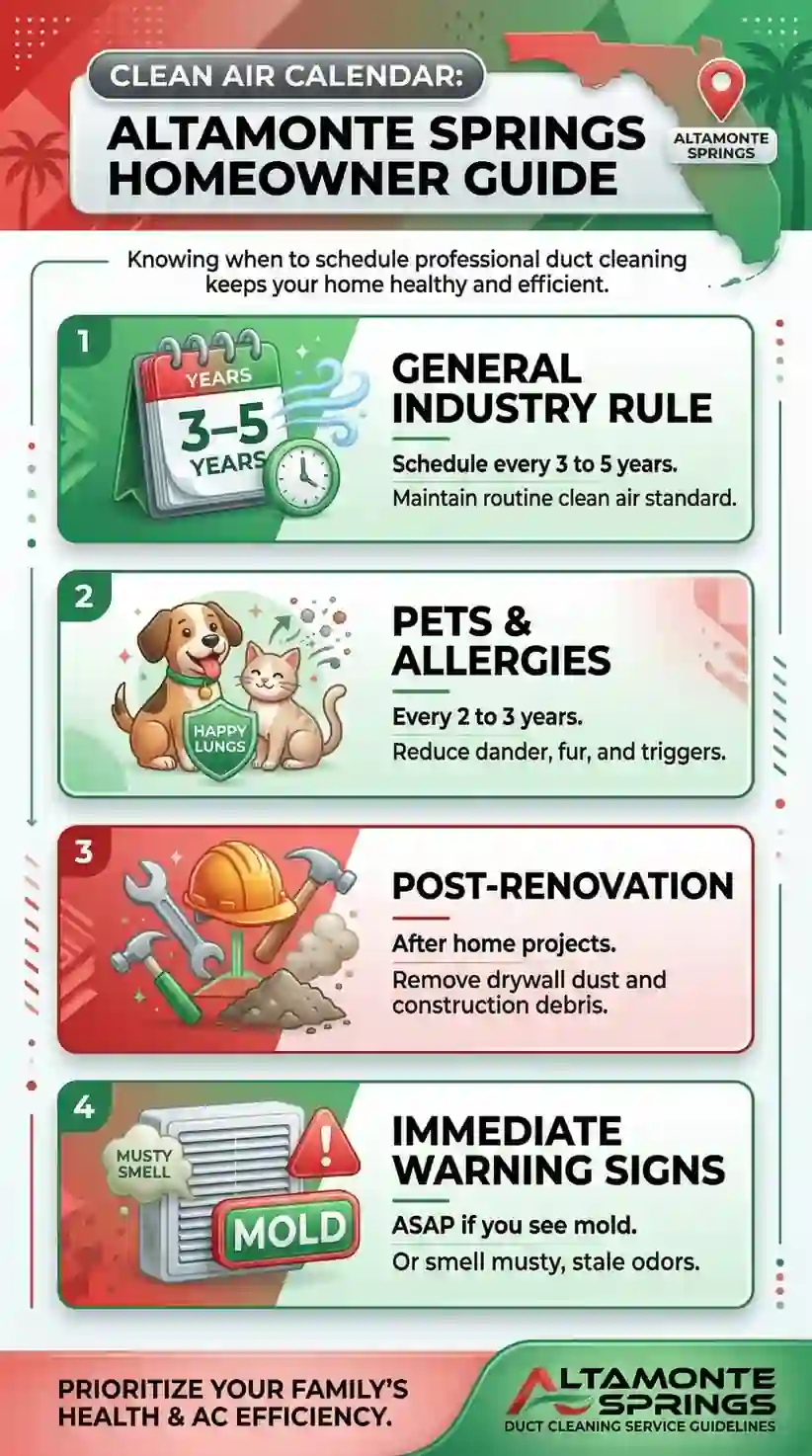
Every 3 years — households with pets, allergy sufferers, older duct systems, or any of the accelerating factors above
Every 3–5 years — well-maintained homes with newer systems, consistent MERV 8+ filter changes, no renovation history, no moisture issues
Sooner than scheduled — any time warning signs appear, regardless of last cleaning date
What we tell every Altamonte Springs homeowner we work with: the calendar is a starting point. What's actually inside your duct system is the real answer. A visual inspection at your registers and air handler, combined with an honest read of your household conditions, will tell you more than any national guideline ever will, and it also shows how regular duct cleaning boosts energy efficiency and overall HVAC performance.
"The 3–5 year national guideline isn't wrong — it's just incomplete for where we live and work. We've inspected duct systems in Altamonte Springs homes where the owner did everything right: consistent filter changes, newer equipment, no pets, no smokers. And we still found contamination levels that national averages wouldn't predict for another two years. Central Florida's humidity and near year-round runtime change the equation in ways that a guideline built on aggregate national data simply can't account for. When we give a homeowner a cleaning frequency recommendation, it's not based on a chart — it's based on what we've actually found behind the duct panel in homes just like theirs, which is often why people searching for duct cleaning near me want clear, experience-based guidance."
Essential Resources
1. EPA Homeowner's Guide — Read This Before Calling Anyone
This is the first resource we point Altamonte Springs homeowners to — not because it sells anything, but because it doesn't. The EPA's guide tells you honestly when duct cleaning is justified, when it isn't, and what provider claims should make you pause. We've seen homeowners come to us after being pressured by companies that never mentioned this document exists.
Source: EPA Indoor Air Quality
URL: https://www.epa.gov/indoor-air-quality-iaq/should-you-have-air-ducts-your-home-cleaned
2. NADCA Certified Professional Directory — The Fastest Way to Verify Who You're Letting Into Your Home
Before any Altamonte Springs duct cleaning company sets foot in your home, check this directory. It confirms whether a certified Air Systems Cleaning Specialist (ASCS) is on staff — the credential that separates companies trained in proper methods from those that bought a shop vac and printed business cards. We're listed here, and so is every provider worth hiring in Seminole County.
Source: National Air Duct Cleaners Association
3. NADCA Homeowner Hub — Know What You're Paying For Before You Compare Quotes
We refer homeowners here before they start collecting quotes because it levels the playing field. It covers what a legitimate cleaning actually involves, what pricing should look like in this market, and how to spot the low-bid offers that dominate Altamonte Springs search results and rarely deliver a complete service.
Source: National Air Duct Cleaners Association
4. Florida DOH Indoor Air Quality Program — Because Florida Isn't Like Everywhere Else
The national IAQ resources homeowners typically find online weren't written for a climate like ours. Florida's DOH program addresses the year-round humidity, continuous AC runtime, and indoor air conditions that are specific to where we live and work. Seminole County homeowners will find county-level contacts here if local guidance is needed beyond what any service provider can offer.
Source: Florida Department of Health
URL: https://www.floridahealth.gov/environmental-health/indoor-air-quality/index.html
5. Florida DOH Mold Resource Page — What We Look for When We Open a Duct Panel
Mold is the finding that changes the conversation during an inspection — and it shows up in Altamonte Springs homes more often than homeowners expect given our humidity levels. This resource helps you understand what visible growth actually means, when remediation goes beyond duct cleaning, and how to address the moisture conditions that will bring it back if left unresolved.
Source: Florida Department of Health
URL: https://www.floridahealth.gov/environmental-health/mold/index.html
6. Florida DBPR License Lookup — A 30-Second Check That Protects You Before Work Begins
Florida law requires a licensed air conditioning or mechanical contractor for duct cleaning work involving partial system disassembly. We verify this standard on every job we run — and we recommend every Altamonte Springs homeowner verify it before booking anyone. This free state tool confirms any provider's license status instantly.
Source: Florida Department of Business and Professional Regulation
7. AirNow.gov — See What Your Duct System Is Up Against Every Single Day
Living and working in Central Florida, we understand firsthand what extended pollen seasons and persistent humidity do to duct systems over time. AirNow puts that in real-time context — showing the actual outdoor air quality and particulate conditions your HVAC system filters daily in the Altamonte Springs area. It's the clearest way to understand why our local cleaning frequency recommendations differ from what national guidelines suggest.
Source: U.S. Environmental Protection Agency / AirNow
These trusted resources help Altamonte Springs homeowners understand the importance оf duсt clеаnіng by explaining when cleaning is necessary, how indoor air quality is affected by humidity, pollen, and mold, and how proper inspections and certified professionals help keep HVAC systems cleaner, healthier, and running efficiently in Central Florida homes.
Supporting Statistics
Indoor Air Is 2–5x More Polluted Than Outdoor Air — and Altamonte Springs Homes Have No Seasonal Escape From It
Most homeowners are surprised when we share this number during an inspection.
Key facts:
EPA documents indoor air pollutant concentrations run 2–5 times higher than outdoor levels
Americans spend roughly 90% of their time indoors
Altamonte Springs homes run AC nearly 11 months a year — windows stay closed, concentration never resets
What this means in practice:
Every home we inspect recirculates the same accumulated particulate continuously
Dust, dander, mold spores, and pollen fragments cycle through living spaces with no seasonal dilution
No ventilation reset means contamination compounds faster than national averages predict
The EPA's data explains what we find in homes where owners are doing everything right — and still wondering why their air doesn't feel clean
Source: U.S. Environmental Protection Agency — Indoor Air Quality URL: https://www.epa.gov/report-environment/indoor-air-quality
Contaminants Recirculate Through Your Home Up to 7 Times a Day — With No Off-Season in Central Florida
This is the statistic that lands hardest during inspections.
Key facts:
NADCA research shows HVAC systems recirculate air 5–7 times daily
Every recirculation cycle moves biological debris, allergens, and particulate through living spaces
25–40% of heating and cooling energy is lost when contaminants force systems to work harder
What we measure in Altamonte Springs homes:
Before-and-after testing shows consistent improvements in airflow and filter loading rates
Efficiency gains are immediate and measurable after professional cleaning
Systems running 11 months a year have no recirculation-free recovery period — ever
In a home running its system continuously, contaminated ductwork isn't a background issue. It's an active daily exposure problem.
Source: NADCA — Benefits of HVAC System Cleaning URL: https://nadca.com/commercial-consumers/benefits-hvac-system-cleaning
Above 50% Humidity, Mold and Dust Mites Don't Just Survive in Ductwork — They Thrive
This is the data point that separates Central Florida from nearly every climate zone the national 3–5 year guideline was built around.
Key facts:
EPA recommends maintaining indoor relative humidity between 30–50%
AAAAI confirms mold and dust mites actively thrive above the 50% threshold
Seminole County outdoor humidity routinely exceeds that threshold for months at a time
What we find inside local duct systems:
Clean grilles and no visible debris at the register — looking unremarkable from the outside
Active biological growth deeper in duct runs where humidity has gone unchecked
Conditions a homeowner following the national guideline has no reason to expect — until we show them what's actually there
Source: American Academy of Allergy, Asthma and Immunology URL: https://www.aaaai.org/tools-for-the-public/conditions-library/allergies/humidity-and-mold
Central Florida's Pollen Calendar Has No True Off-Season — and Local Duct Systems Show It
This is the factor we reference most when Altamonte Springs homeowners push back on a 3-year recommendation.
Key facts:
CDC documents pollen seasons are growing longer and more intense
Longer seasons directly increase allergen exposure and asthma triggers for sensitive populations
Rising temperatures and humidity accelerate outdoor pollen production and indoor mold growth simultaneously
What this looks like in Seminole County:
Live oak, pine, and grass pollen cycles overlap nearly continuously
No meaningful break between seasons — organic particulate loads return air systems year-round
National guidelines assume a pollen season with a start and an end — Central Florida's doesn't have one
When we show Altamonte Springs homeowners the organic buildup we consistently find in local duct systems, the 3-year recommendation stops feeling aggressive. For many households we inspect, it starts feeling conservative.
Source: Centers for Disease Control and Prevention — Allergens and Pollen URL: https://www.cdc.gov/climate-health/php/effects/allergens-and-pollen.html
Final Thought & Opinion
Most Altamonte Springs homes need duct cleaning every 3 years. That position comes from what we've found inside duct systems across Seminole County — not from a national guideline built on data that doesn't reflect this climate.
What the data tells us:
Indoor air runs 2–5 times more polluted than outdoor air — with no seasonal dilution here
HVAC systems recirculate that air up to 7 times daily
Humidity above 50% creates active biological growth conditions inside ductwork
Central Florida's pollen calendar has no true off-season
What the work tells us:
Attentive homeowners with newer systems still show contamination levels that surprise them
The national 3–5 year guideline wasn't built for this climate
Most local homes hit the meaningful cleaning threshold closer to year 3 than year 5
Pets, allergy sufferers, and older duct systems often push that timeline even earlier
Our opinion, plainly stated:
The duct cleaning industry has a credibility problem — and it earned it.
Low-bid offers, fear-based sales tactics, and cleaning schedules pushed regardless of actual home conditions have made homeowners reasonably skeptical. We've spoken with homeowners who quoted emergency mold remediation by the same technician who showed up for a $99 special — and handed them the remediation quote on the spot. That's not a service call. That's a script.
What we've learned inspecting homes across this area:
Frequency has a real, defensible answer — but only when grounded in actual conditions
Not every home needs cleaning every 3 years — some need it sooner, some hold closer to 5
The difference comes down to humidity exposure, household factors, filter strategy, and what we actually find behind the panel
What we recommend:
Start with an honest visual inspection at your registers and air handler
Assess your household conditions against the accelerating factors on this page
Check your last cleaning date against the 3-year Central Florida baseline
If two or more warning signs are present — don't wait for a scheduled interval
Verify any provider's Florida license and NADCA certification before booking
The homeowners who make the best decisions aren't the ones who book a cleaning every time someone knocks on the door. They're the ones who understand their home's specific conditions and act on honest information. That's exactly the standard this page was written to support.
FAQ: How Often Should Altamonte Springs Homeowners Get Duct Cleaning?
Q: How often should Altamonte Springs homeowners schedule professional duct cleaning?
A: Most Altamonte Springs homes need cleaning every 3 years. That number comes from opening duct panels across Seminole County — not from a national guideline.
Why the local baseline is earlier than national averages:
Near year-round AC operation with no seasonal recovery period
Humidity regularly exceeds 50% — where mold and dust mites stop being a risk and start being a reality
Pollen cycles run almost continuously — live oak, pine, and grass with no true off-season
Where your home lands within that range:
Pets, allergy sufferers, smokers, older systems, recent renovation — closer to 3 years or sooner
MERV 8+ filters changed on schedule, newer systems, no occupancy risk factors — may hold to 4–5 years
The calendar is a starting point. What's inside your duct system is the real answer.
Q: What are the warning signs that my Altamonte Springs home needs duct cleaning sooner than scheduled?
A: The homes that concern us most aren't obviously neglected. They're well-maintained homes where the local climate outpaced a reasonable schedule.
Act immediately if two or more of these apply:
Musty odors returning within days of a fresh filter change
Dust visible at registers shortly after cleaning them
Allergy or asthma symptoms worse indoors than outside
Visible mold at registers or the air handler
Pest evidence inside the duct system
No cleaning on record after renovation or construction
We've inspected homes where one warning sign was present for over a year before the homeowner acted. By that point contamination had compounded well beyond what a timely cleaning would have addressed. Two or more presents at once — don't wait.
Q: Why do Altamonte Springs homes need duct cleaning more frequently than the national guideline suggests?
A: The national guideline wasn't written for where we live and work. Three factors make Central Florida a different equation entirely:
Year-round AC operation — approximately 11 months of continuous runtime. No seasonal pause means no recovery period between contamination cycles.
Persistent humidity — Seminole County regularly exceeds the 50% biological growth threshold. We've opened systems that looked clean at the register and found active mold growth deeper in the duct runs.
Extended pollen seasons — live oak, pine, and grass cycles overlap almost continuously. The national guideline assumes a pollen season with a beginning and an end. In Central Florida, that assumption doesn't hold.
When homeowners see what we consistently find in local systems, the 3-year recommendation stops feeling conservative. For many households, it starts feeling like they waited too long.
Q: How does filter maintenance affect how often I need professional duct cleaning?
A: This is the question we wish more homeowners asked before their first cleaning.
What we see consistently across Altamonte Springs homes:
Low-MERV filters changed infrequently — contamination returns in 18–24 months
MERV 8+ filters changed on schedule — cleaning holds reliably closer to the 3-year mark
Ducts cleaned without adjusting filter strategy — cleaning doesn't hold as long as it should
How the two services work together:
Professional cleaning removes existing buildup — resets the system
MERV 8+ filter changed on schedule slows how fast buildup returns
Skipping one shortens the effectiveness of the other
If you've invested in a professional cleaning, a consistent MERV 8+ filter strategy is the single most effective way to protect that investment.
Q: How do I verify that a duct cleaning company in Altamonte Springs is qualified to do the work?
A: Start with two verifications before the conversation begins. We recommend this to every homeowner — including ones considering hiring us.
Two non-negotiables:
Florida contractor license — required by law for any duct cleaning involving partial system disassembly. Verify at MyFloridaLicense.com
NADCA certification — confirms a certified Air Systems Cleaning Specialist (ASCS) is on staff. Search at nadca.com/find-a-professional
Questions that separate thorough providers from shortcut operators:
Does the service cover the full system — supply ducts, return ducts, registers, and air handler?
Do you use truck-mounted or HEPA-filtered negative pressure equipment?
Will you provide before and after documentation?
Is pricing flat rate or per vent?
We've heard from homeowners who asked these questions and watched a provider pack up and leave rather than answer them. That response told them everything they needed to know.
In How Often Should Altamonte Springs Homeowners Get Duct Cleaning?, the best rule of thumb is to base timing on what’s happening in your home (pets, allergies, recent renovations, visible dust at supply vents, musty odors, or persistent airflow imbalance) rather than a generic calendar date, because your ductwork only stays clean when your system is consistently trapping particles and moving air correctly; that’s why pairing duct cleaning with the right filter fit and a reliable change cadence is the practical move that keeps results lasting longer between cleanings. For example, keeping a properly sized pleated filter installed and changed on time such as a 20x21.5x1 MERV 8 pleated furnace filter helps reduce the dust load that would otherwise settle back into ducts, while a common return size like 20x20x1 MERV 8 pleated HVAC air filters 4-pack makes it easier to stay consistent without running out mid-season. If you’re shopping around for comparable replacements, an option like an 18x20x1 MERV 8 pleated HVAC air filter can support the same goal: cleaner air moving through the system, less debris cycling through the duct network, and fewer reasons to need duct cleaning as often.